The Stewardship Layer: Making Global Arts Events Feel Native to Their Setting
The most convincing cultural journeys are not defined by access alone. They are shaped by the quiet stewardship that connects artistic intent, local context, guest movement, and operational certainty across borders.
A global arts experience can be impeccably arranged and still feel somehow external to the place in which it occurs. The venue may be distinguished, the programme may be desirable, and every transfer may be on time. Yet cultural value is not created by coordination alone. It emerges when the event, its setting, and its guests are brought into the same frame of reference.
This is the often-overlooked layer of a full arrangement service: stewardship. It is the discipline of holding the entire cultural journey together without flattening its local character. For clients seeking a privileged and immersive cultural experience, the question is not simply how to attend an event. It is how to enter it with the right context, the right pace, and the right degree of discretion.
Beyond access: the work of cultural translation
International arts programming is inherently multi-layered. It can involve a performance, exhibition, festival, private viewing, artist encounter, or cultural institution, while also requiring venue coordination, ticketing, guest communication, travel planning, and on-site care. Industry guidance on arts and culture event management describes the field as a combination of artistic programming, venue scheduling, logistics, ticketing, guest experience, and partner coordination.
The practical implication is important: a cultural occasion cannot be treated as a ticket with surrounding logistics. The surrounding logistics are part of the meaning. A museum after-hours visit, an opera premiere, a contemporary art fair, or a private gallery programme each has its own codes of arrival, attention, conversation, and departure.
A thoughtful planner does not impose one universal luxury template on all of them. Instead, the planner interprets the event's character and builds a journey that allows the guest to recognise it.
This is cultural translation in its most useful form. It does not over-explain the experience or turn it into a performance of privilege. It makes the right details available at the right moment, allowing the setting to remain in focus.
Why the setting is part of the programme
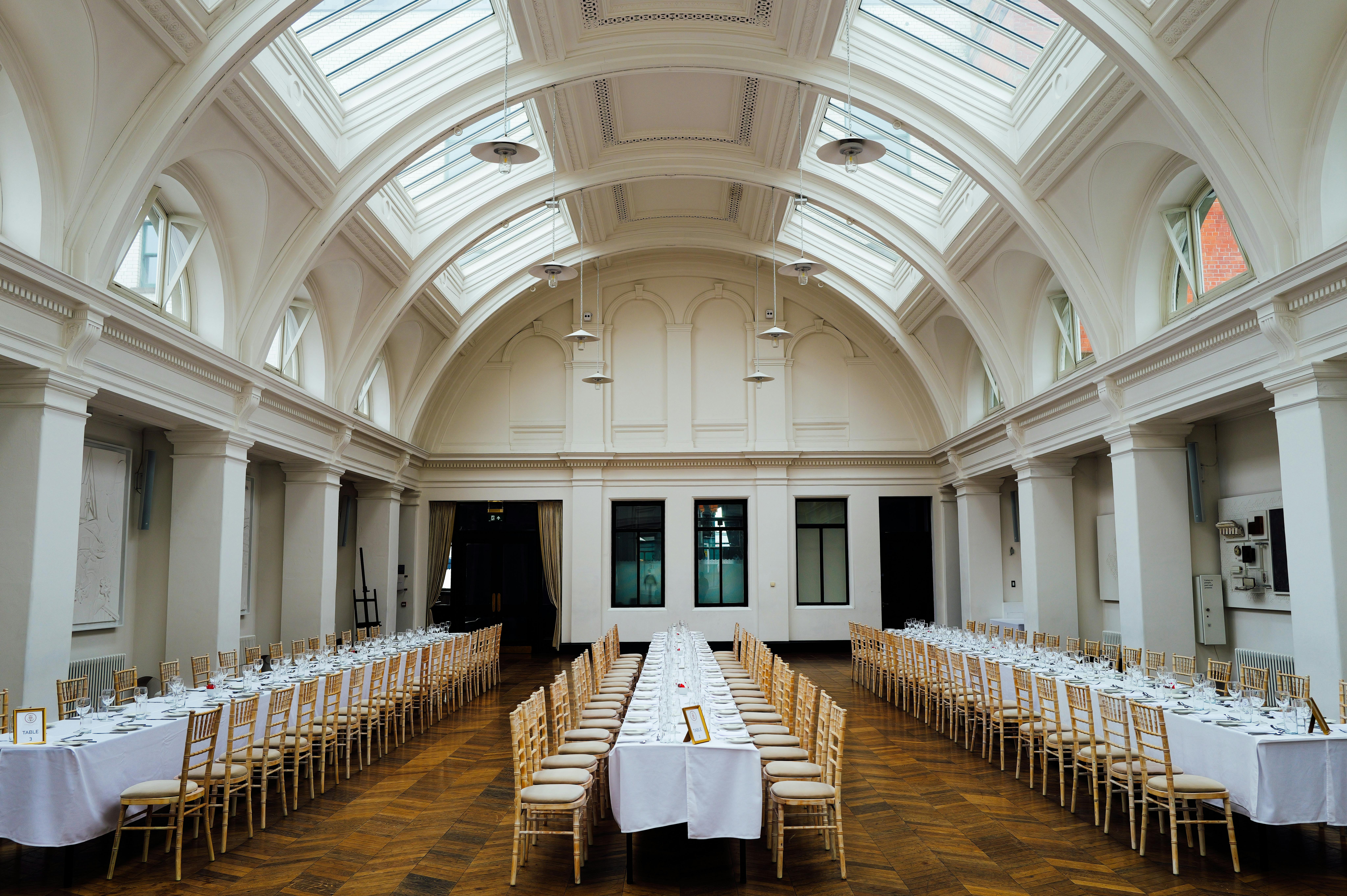
Venue sourcing is often described as a logistical requirement. In the arts, it is more accurately a curatorial decision. The scale, acoustics, architecture, neighbourhood, access route, and relationship with the surrounding city all affect how an audience receives the work. The venue is not a neutral container; it establishes a first interpretation before the programme begins.
This is why full arrangement requires more than finding a prestigious address. It requires assessing whether a space is suitable for the artistic intention and the guest profile, whether movement through it feels natural, and whether the practical plan protects the integrity of the occasion. A culturally intelligent arrangement may favour intimacy over spectacle, proximity over scale, or a less obvious setting whose significance becomes apparent only through context.
The best result is not necessarily the most visible one. It is the one in which the place, the programme, and the guest experience appear to belong together.
One chain of responsibility, quietly maintained
Cross-border events add another level of complexity. International organisers must often coordinate local suppliers, regulations, cultural expectations, time zones, access procedures, and on-site teams. A 2026 review of international event organisers identifies global expertise, end-to-end execution, cultural nuance, standardised processes, and risk reduction as central requirements for reliable events across countries.
For a private client, these requirements should not become visible as operational noise. They should be absorbed into a single, calm chain of responsibility. The value of a full arrangement service lies in the continuity between decisions: the initial brief informs the event selection; the event selection informs the venue and travel plan; the travel plan informs arrival timing; arrival timing informs access and hospitality; and the experience itself informs what should happen afterwards.
This continuity is especially important when a journey moves between public and private settings. A guest may begin with a major international performance, continue to a collection viewing, and end with a carefully chosen dinner or conversation. Each element should have its own identity, but none should feel accidentally placed beside the others. The service is not simply to fill a calendar. It is to protect the relationship between moments.
| Arrangement layer | The question it should answer |
|---|---|
| Cultural brief | What kind of attention, discovery, or participation is the client seeking? |
| Programme and artist context | Why does this event matter, and what makes it distinctive? |
| Venue and access | How should the setting shape the experience rather than merely host it? |
| Guest movement | Where can time, privacy, and ease be preserved? |
| On-site execution | Which details should remain invisible to the guest? |
| Aftercare | What should remain meaningful when the event has ended? |
The table is not a checklist for the guest. It is a discipline for the advisor.
The quiet standard of full arrangement
A full arrangement service should not be measured only by the number of components it can supply. Public descriptions of luxury art event planning commonly combine venue sourcing, artist curation, production, guest management, marketing, and full-service execution. Those capabilities are useful, but their real value depends on judgement: which elements are necessary, which should be declined, and which should remain deliberately understated.
For VERTU, this distinction is central to the idea of arts, culture, and patronage advisory. The service is not positioned as a mass event marketplace or a conventional concierge transaction. It is a considered route into significant cultural occasions, designed for clients who value access but also context; exclusivity but not display; and convenience without the loss of discovery.
That approach also creates a more credible relationship with the cultural world. Artists, institutions, galleries, festivals, and venues each have their own priorities and protocols. A responsible planner respects those distinctions rather than treating them as interchangeable inventory. The client receives a more coherent experience, while the cultural setting retains its dignity and specificity.
Designing the experience before the itinerary
The most effective first step is not to ask which event is available. It is to define the quality of experience that should be created. Is the purpose private appreciation, intellectual discovery, a meaningful introduction to a city, a discreet celebration, or a deeper relationship with a cultural field? The answer determines the rhythm of the arrangement.
From there, the itinerary can be designed around a small number of strong decisions. A carefully selected event may be more valuable than a crowded programme. A well-timed introduction may matter more than an additional reservation. A short period of unstructured time may be essential to allowing the experience to settle.
This is where the stewardship layer becomes visible - not as spectacle, but as confidence. The guest does not need to see every moving part. They should feel that the journey has been considered in full, that the cultural setting has been understood, and that each transition has a reason to exist.
A more intelligent definition of privilege
Privilege in cultural travel is often reduced to proximity: the best seat, the closed door, the invitation that others cannot obtain. Those forms of access may have value, but they are not the whole experience. A more enduring form of privilege is the ability to meet a place and its culture without unnecessary friction, while retaining the freedom to pay attention to what makes the moment singular.
That is the promise of Full Arrangement for Global Arts and Culture Events: not simply to secure entry, but to compose the conditions in which an event can be properly received. Through cultural judgement, discreet execution, and worldwide coordination, the journey becomes more than a sequence of bookings. It becomes a form of participation - privileged, immersive, and appropriately attuned to where it takes place.